The Hidden Token Cost of Flat .cursorrules Files
The flat rules file token cost is the quiet tax almost every AI-coding setup pays. A single .cursorrules file at your repo root feels tidy. Yet the model re-reads the entire blob on every prompt, whether or not the task touches it. Furthermore, grow the file and you grow the per-request bill, the latency, and the odds the agent applies the wrong rule to the wrong file. This piece measures that cost. Then it shows how routed, on-demand skills fix it — the same shift we mapped in our guide to AI coding conventions.
What is the flat rules file token cost?
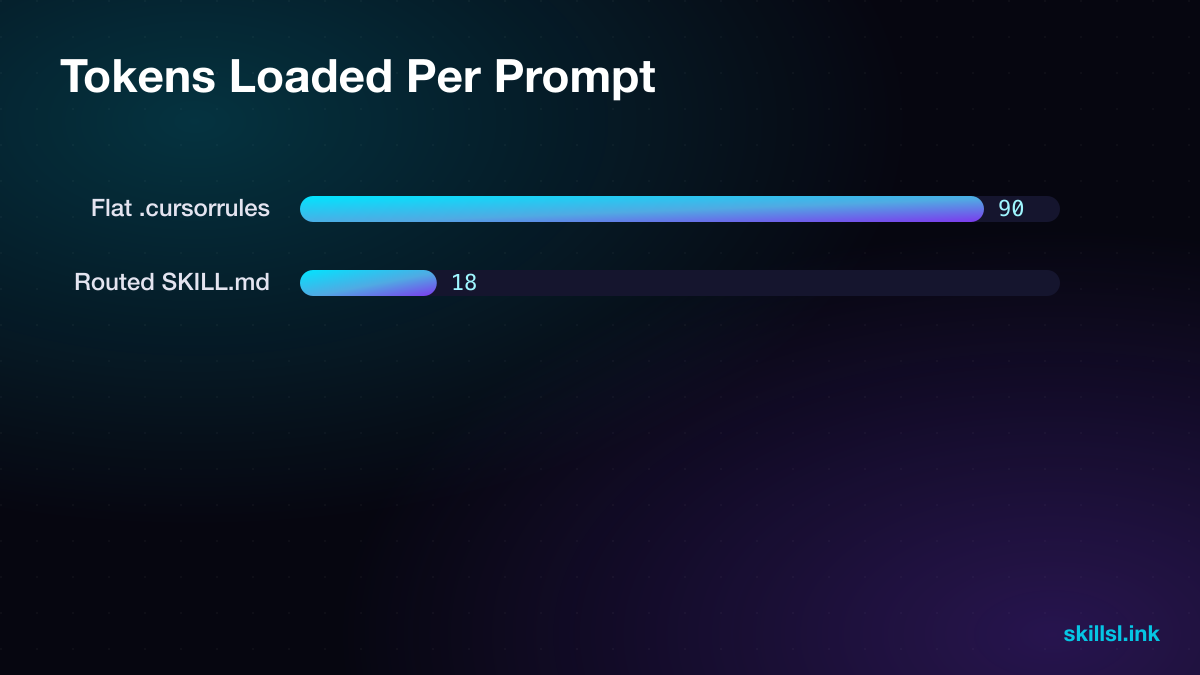
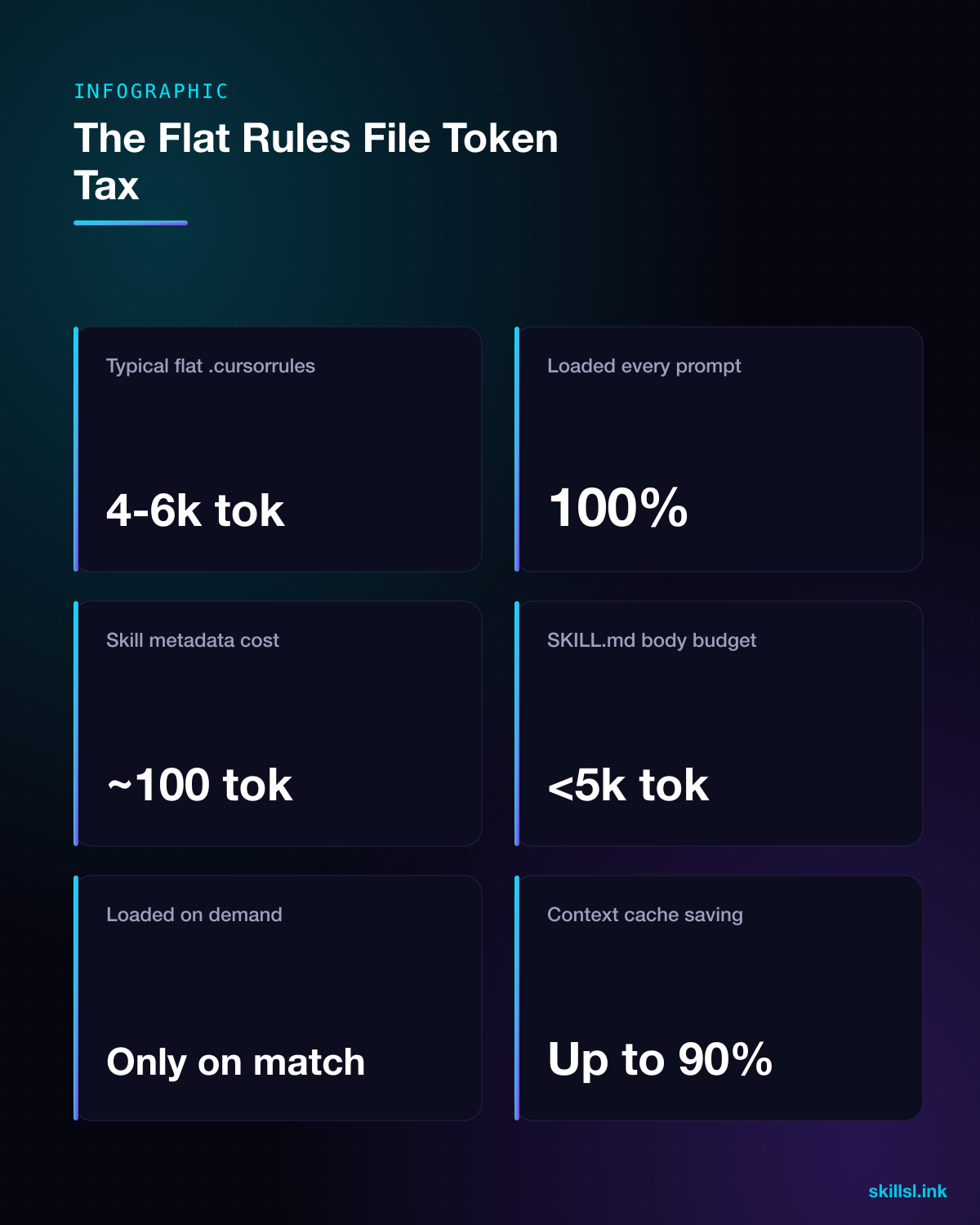
The flat rules file token cost is the tokens a monolithic instruction file (like .cursorrules) adds to every prompt. In other words, the model must load the whole file as context each turn. So a 5,000-token file across 100 prompts becomes 500,000 tokens of pure overhead, most of it irrelevant to any one task.
Why flat files feel free but aren't
You write a rules file once and forget it. The model, however, re-reads it on every request. It has no memory between turns, so your conventions must travel with each prompt as context. That mechanism drives the cost, and it stays invisible until you count it.
- Scales with prompts, not edits. You write the file once, yet you pay for it on turn 1, turn 2, and turn 500.
- Scales with file size. Each new framework note, security caveat, and style rule adds tokens to every future request.
- Competes for the context window. A token spent on dormant rules is a token denied to your actual code.
Where the tokens actually go
For example, picture a repo with backend, frontend, testing, and deployment rules in one file. A simple CSS tweak still ships the database migration policy, the webhook signing rules, and the security checklist. None of it applies. Yet all of it arrives as context, so the model must read past it to reach the task. That dead weight is the flat rules file token cost in its purest form, and it never shrinks on its own.
Worse, the irrelevant rules do more than cost tokens. Additionally, they dilute attention. The model now weighs a payments caveat against your CSS change, and occasionally it guesses wrong. Instead, a lean prompt sidesteps that failure mode entirely.
How to measure the flat rules file token cost
You do not need a profiler. A rough count makes the problem concrete, and the word-to-token ratio is well known. OpenAI's tokenizer guidance puts English text at roughly 0.75 words per token. So divide your word count by 0.75 for a usable estimate.
Run this at your repo root:
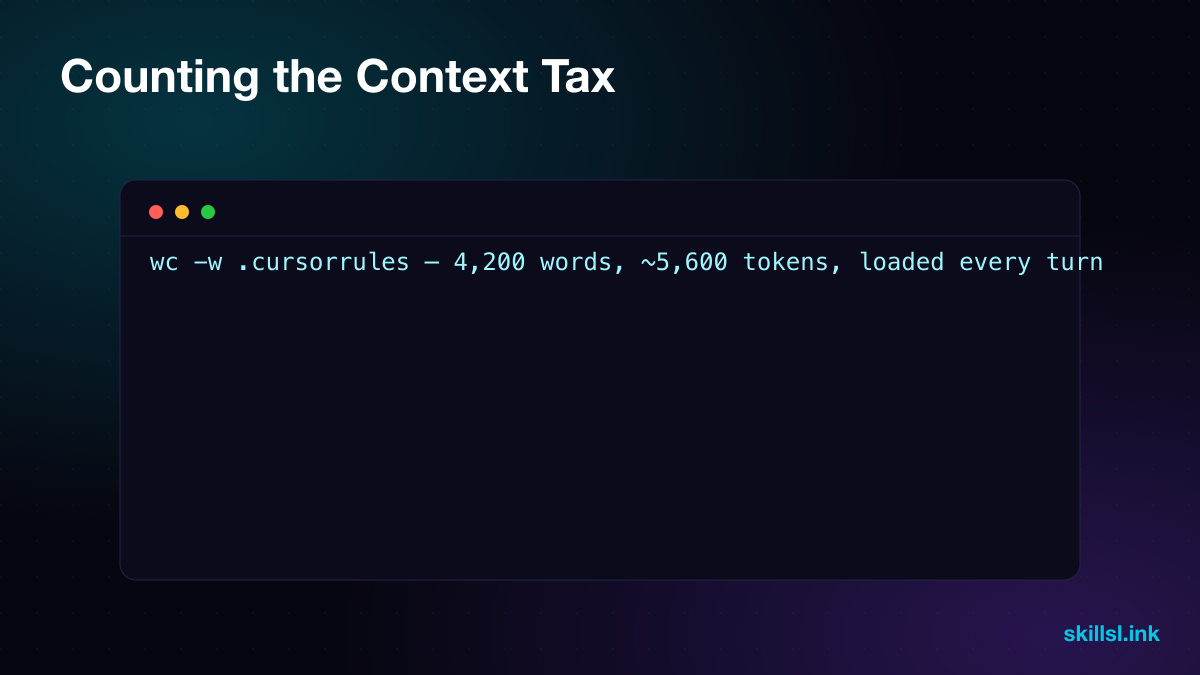
wc -w .cursorrules
# 4200 words  ->  ~5600 tokens, loaded on EVERY prompt
Now multiply by your session volume. The table below shows how a modest flat file balloons into real overhead across a typical coding day.
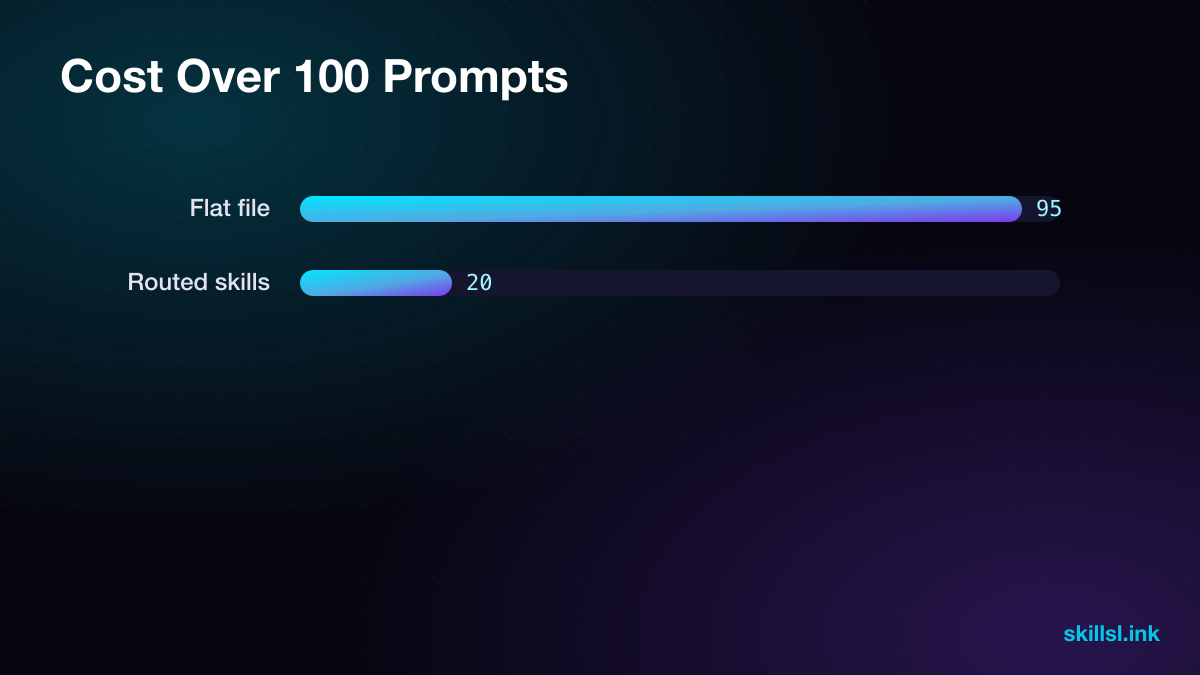
| Prompts in a session | Flat file (5.6k tok each) | Routed skills (~1k tok each) | Tokens saved |
|---|---|---|---|
| 10 | 56,000 | 10,000 | 46,000 |
| 50 | 280,000 | 50,000 | 230,000 |
| 100 | 560,000 | 100,000 | 460,000 |
| 250 | 1,400,000 | 250,000 | 1,150,000 |
Consequently, the pattern is stark. A flat file charges its full size on every turn, whereas a routed system charges only for the one skill the task needs. Moreover, we unpacked this same fragmentation problem in our guide to AI coding conventions, and here it shows up as raw tokens.
A five-step audit you can run today
Measuring the flat rules file token cost takes about two minutes. Follow these steps and you will know your exact overhead before you refactor anything.
- Count the words. Run
wc -w .cursorrulesat the repo root. Note the number. - Convert to tokens. Divide the word count by 0.75. A 4,200-word file is roughly 5,600 tokens.
- Count your prompts. Check a typical session. Many developers send 50 to 150 prompts per day.
- Multiply the two. Tokens times prompts gives your daily overhead. At 5,600 tokens over 100 prompts, that is 560,000 tokens.
- Compare to routed loading. A routed system loads roughly 1,000 tokens per matched task. The gap between the two numbers is your savings.
The exercise reframes the problem. A flat file does not cost you once; it bills you per request, and the bill grows with every rule you add.
How routing fixes the flat rules file token cost
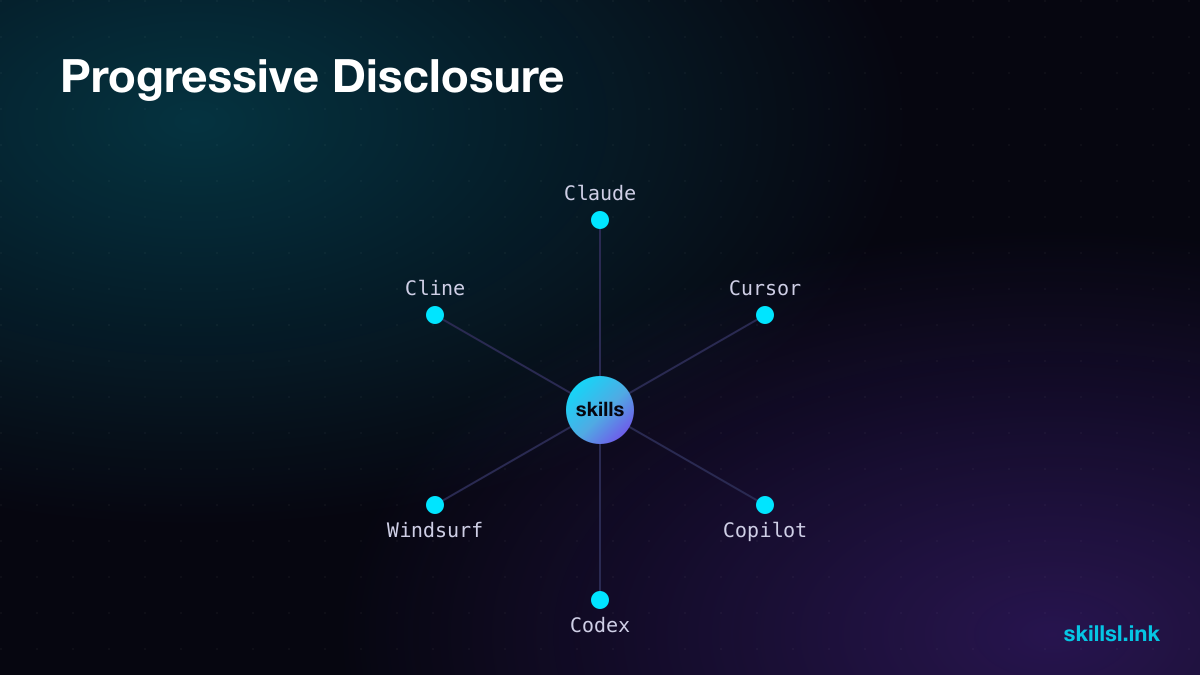
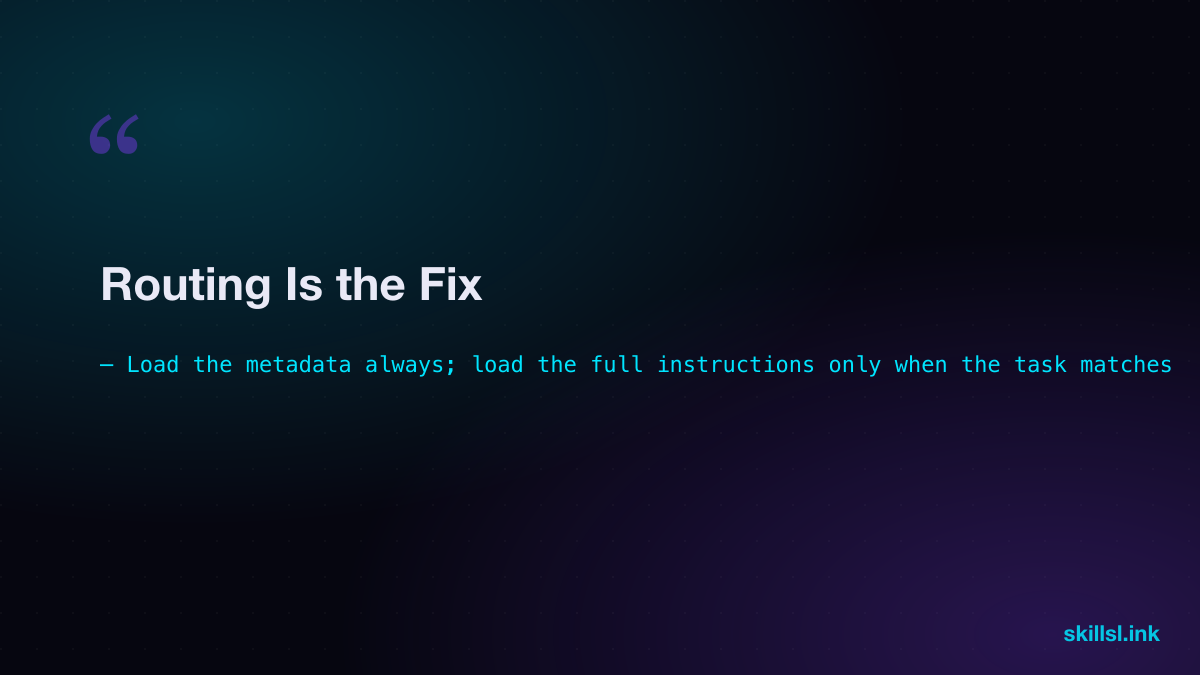
Routing replaces "load everything, always" with "load metadata always, load the body only on a match." Anthropic's Agent Skills pack each instruction set into a folder with a SKILL.md file that declares a name and a short description. The model reads only that metadata at startup. When a task matches, it then loads the full skill body. Anthropic calls this progressive disclosure, and it is the core mechanism that beats the flat rules file token cost.
The economics flip entirely:
- Metadata is cheap and always present. A skill's name and description cost roughly 100 tokens, so dozens of skills sit on standby for the price of one small paragraph.
- The body loads only on demand. Similarly, a
SKILL.mdbody stays under 5,000 tokens and loads only when the model routes to it, so an unused skill costs almost nothing. - Resources load last. Finally, scripts, references, and examples live in linked files that the model opens only when it needs them, a third lazy layer below the body.
Why routing beats partial fixes
Cursor itself moved on from the flat format. Its newer .cursor/rules/ directories let each rule carry globs and activation modes. GitHub Copilot offers path-scoped *.instructions.md files, as the GitHub Copilot docs describe. Both patch the worst of the token cost by scoping rules to file paths. They beat one blob, and that counts.
Still, path matching differs from task reasoning. A glob fires on where you edit, not what you set out to do. By contrast, routing driven by the model's own understanding loads the payments skill for payments work and the testing skill for test work, even when the files hide the intent. As a result, that precision turns a fixed tax into a genuine pay-per-use model.
The compounding math
Compounding is the reason this matters. Every prompt, every session, every day of development multiplies a flat file's cost. Trim 5,000 tokens of dormant context off each turn and the savings stack into the millions over a busy week, even before the cache. Routed metadata forms a stable prefix, so it also benefits from prompt caching, which Anthropic says can cut repeated-prefix costs by up to 90%. A flat file shuffled or regrown each turn defeats that cache entirely.
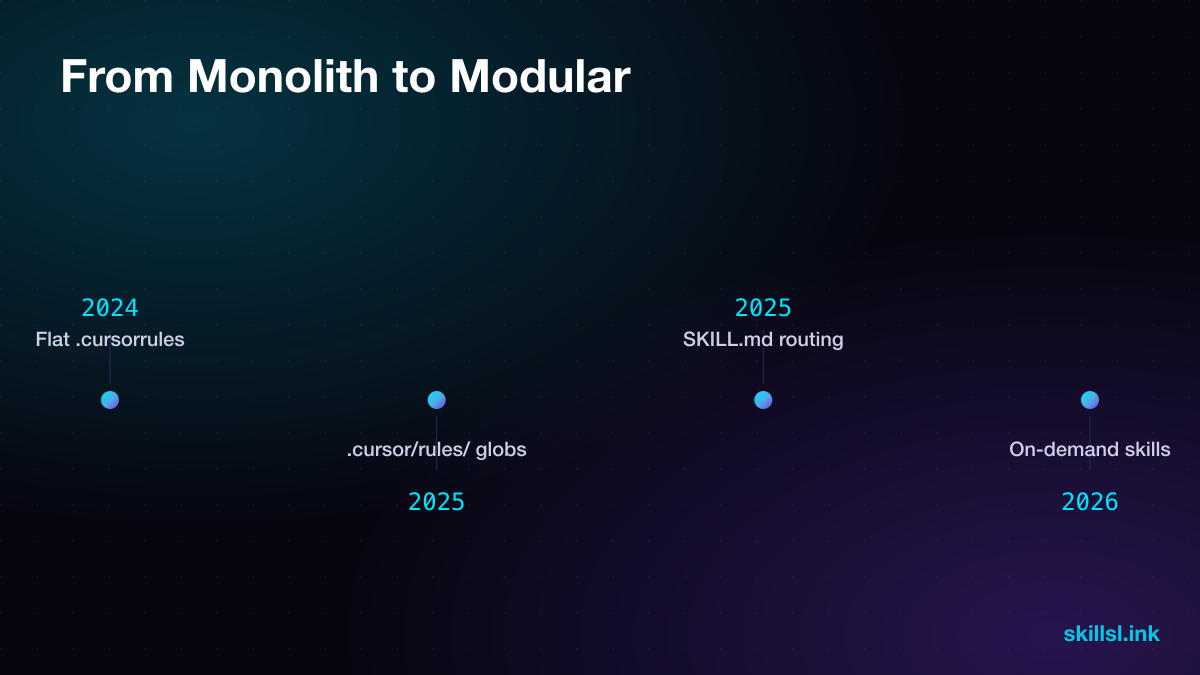
Beyond the dollars sits a quality dividend. A lean context window lets the model spend its attention on your code, not on wading through rules that do not apply. Fewer wrong-context edits, tighter diffs, and faster responses all follow from loading less.
Common mistakes that inflate the flat rules file token cost
Teams rarely set out to overpay. Instead, a few habits quietly drive the flat rules file token cost upward. Watch for these four.
- Dumping every convention into one file. A single
.cursorrulesthat covers backend, frontend, infra, and security sends all of it on a one-line copy fix. Split by concern instead. - Pasting whole style guides inline. A linked style guide the model reads on demand beats a 2,000-word block it reads every turn. Reference it; do not embed it.
- Leaving dead rules in place. Rules for a framework you dropped last quarter still cost tokens. Prune ruthlessly, because every stale line bills on every prompt.
- Reordering the file often. Shuffled content breaks the prompt cache, so you pay full write cost again. A stable prefix is what the cache rewards.
Each habit looks harmless in isolation. However, together they turn a tidy file into a compounding tax that scales with your busiest days.
How to measure your savings after routing
Once you route your conventions, confirm the win rather than assume it. First, capture a baseline: your flat file's token count multiplied by a day's prompt volume. Next, run the same workload through routed skills and log the tokens the model actually loads. Finally, subtract. The delta is real, recurring savings, and it typically lands between 70% and 90% per prompt.
Most AI tools expose token usage per request in their logs or dashboards. Therefore check those numbers before and after the switch. Seeing the per-prompt load drop from thousands to hundreds makes the abstract tax suddenly concrete, and it proves the refactor paid off.
Flat rules file token cost: frequently asked questions
Does a flat rules file really load on every prompt?
Yes. The model holds no memory between turns, so your conventions must travel with each request as context. Therefore a 5,600-token file is re-sent on prompt 1 and on prompt 500 alike, which is exactly why the flat rules file token cost compounds so quickly.
How many tokens does a typical .cursorrules file add?
Most mature flat files run 4,000 to 6,000 tokens. Across 100 prompts, that is 400,000 to 600,000 tokens of pure overhead per day, nearly all of it irrelevant to any single task you actually asked for.
Can I just make my flat file shorter?
Trimming helps, yet it treats the symptom. A shorter file still loads in full every turn. Routing fixes the mechanism: it loads only the one skill a task needs, so the fix is architectural rather than editorial.
Do routed skills hurt response quality?
No; they usually improve it. A lean context window lets the model focus on your code instead of dormant rules, which means fewer wrong-context edits and tighter diffs. You pay for less and you get sharper output.
The verdict
A flat .cursorrules file makes a convenient default, yet it quietly scales its cost with every prompt you send. Therefore the fix is architectural, not editorial. Route your conventions into small, triggered skills. Then the metadata stays available and the detail loads only when a task demands it. In short, that approach beats a flat file on tokens, on latency, and on relevance, and it keeps compounding in your favor as your project grows.
Want to see which tools read routed skills and keep your context lean? Explore the supported editors and build a portable skills profile at skillsl.ink that travels across every AI coding tool you use.